Feeds:
Posts
Comments

14th May 2013

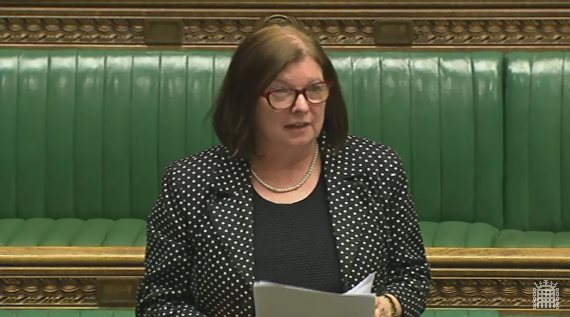
On Monday, I spoke in the Queen’s Speech debate on Health and Social care to question the Government’s Care Bill. What is clear following the debate is that the Health Secretary, Jeremy Hunt, doesn’t recognise the detrimental effects his government’s cuts are having upon our National Health Service and the quality of care people are receiving.

The Bill fails to address the growing funding gap in our social care provision and the additional pressure this is putting on local services. The Government’s proposals will do nothing to close the funding gap or to help the thousands of people who are already suffering with spiralling living costs and increases to home care costs.

I also raised my concerns about the lack of support in the Bill for indentifying and supporting young carers. This is just one of the many areas that need to be addressed as the Bill makes its way through the House, and I hope the Government will work with Labour on these issues.

My full speech is below and the full debate can be read here:

http://www.publications.parliament.uk/pa/cm201314/cmhansrd/cm130513/debtext/130513-0002.htm#130513-0002.htm_spnew57

“My hon. Friend Paul Blomfield  made a powerful case against the influence of the tobacco companies and their lobbying of this Government, and the utter ineffectiveness of the Prime Minister in standing up to them. I am also pleased to follow Mr Ward, who made an impassioned plea on behalf of his constituents and others. He demonstrated the need for proper local authority funding to support care services, and I will address that later in my speech.

I think it is true to say that all independent commentators are noting that the Gracious Speech was very thin and did not rise to the many challenges facing this country, particularly the need for economic growth. I was therefore concerned to hear speech after speech in which Conservative Members talked only about Europe in a very obsessive way, without any recognition of the fact that constituencies such as mine that are desperately in need of economic growth rely on our relationship with Europe. Our region exports the most from this country, and a huge proportion of our exports are to European countries. We need

those exports to grow, not to be damaged by the rhetoric on Europe that we hear day after day from the Government and Conservative Members.

I was also concerned when I listened to the Secretary of State for Health and heard how complacent he is about the state of the NHS. He showed no recognition at all of the anxiety of many of my constituents about what sort of health service we are going to end up with in a couple of months’ time and whether it will be able to meet their most basic needs. He showed no awareness at all of the challenges facing A and E departments right across the country, including my own in Durham. I am not criticising the staff, who struggle against the odds to provide the best care. This is happening because the Government are not looking at how to use the resources effectively and how to channel them towards under pressure A and E departments.

It would be extraordinary if we did not have a Bill on care in this Queen’s Speech given the clamour for it from carers, carers’ organisations, other agencies, cross-party commissions, and cross-party groups, and some of the work that Labour did when in government. The question remains, however: is the Bill up to the job of dealing with the problems facing our care system, which need to be addressed urgently because, as we all know, it is in danger of falling into crisis. The House of Commons Library has produced research showing that 10 million people in the UK are over 65 and that by 2030 the number is projected to rise to 15.5 million. Many of these additional older people will have care needs, putting increasing pressure on our care system. At the same time, more funds are being stripped from social care. The £500 million funding gap in our social care provision is still growing and, as Age UK has made clear, this is having a hugely detrimental impact on the care received by our elderly people. Age UK states that

“the widening funding gap has led to a reduction in service provision, increasing charges levied by councils for their services and less older people receiving the support they need.”

It further says:

“Every older person using local authority care services is now being charged £150 per year more in real terms in 2010-11 than in 2009-10, and £360 more than 2008-09”.

The situation is expected to get worse still. Due to the massive cuts faced by local government, by 2013-14 local authorities will have reduced their expenditure on adult social care by £2.7 billion—a massive 18% reduction when demand is increasing all the time. Clearly, this is not sustainable.

The Bill will do nothing to close the growing funding gap or to help the thousands of people who are already suffering with spiralling living costs and increases to home care costs. These people find themselves passed between care providers, often without any continuity of service. We will all have heard about such experiences in our constituency surgeries. Many people are ending up in hospital unnecessarily because they are not getting the care they need at home. Similarly, the Government’s earlier decision to ignore Dilnot and the experts who recommended a maximum cap of £35,000 and set it at £72,000 plus accommodation costs will not help many of my constituents, particularly those on lower or middle incomes.

Where the Bill might make some meaningful progress is with regard to improved rights and support for carers, but, as several hon. Members have said, there are huge

gaps, particularly in identification of and support for young carers. That will need to be addressed as the Bill makes its way through the House. More needs to be done to support the various organisations that help carers. I work with a number of voluntary sector bodies in my local communities, and they are very worried that they will go out of business because they are not able to get enough resources to keep going.

Carers UK has set out some tests of this Bill. It says that it needs to be underpinned by appropriate funding, that it must promote the well-being and dignity of all our elderly residents, that it must ensure that independent advice is available to people and that there are appropriate advocacy services, that it should make sure that the criteria for people to get support are clear and transparent —it is no good just having assessments; they have to produce something in the form of appropriate levels of care—and that it must guarantee continuity of service and portability in whatever care support is given. I hope that as the Bill goes through the House it will be tested on those criteria.”

Image

Yesterday I addressed the conference of the National Infrastructure Planning Association. It was an excellent conference, including many of the industry’s leading experts. You can read my speech on the importance of infrastructure below. 


The current infrastructure pipeline is currently valued at £310 billion. (As you no doubt heard from the Minister earlier) These projects could provide an enormous boost the flat lining economy –  but in reality the vast majority of these sites are stalled.


No one in this room can be in any doubt about the importance of bringing forward these projects quickly, smoothly and effectively.


Indeed there are very few people in Westminster who need convincing either. The important role that infrastructure will play in our economic recovery and must continue to play for a sustainable and competitive economy is almost universally recognised in Parliament and Whitehall.


There is a strong political case for improved infrastructure delivery too. Not only would it create jobs, but without government finance it is consumers that will bear the brunt with higher fares, slower commutes and rocketing bills.


As a result the Government is under increasing pressure to do something about the huge number of major infrastructure projects currently languishing on the backburner.


This has been reflected in the raft of legislative measures brought forward  which tinker with the major infrastructure planning regime as most recently seen in the Growth and Infrastructure Act. The need for a boost to infrastructure has also been acknowledged by the Treasury which promised £3billion a year more capital spending in this year’s budget.


However, these claims are worthless unless they are backed up with a long-term strategic plan of what we are going to deliver, when, where and how.


George Osborne’s plan to attract £20 billion of infrastructure investment from sovereign wealth funds has attracted just £1 billion.


Only 14% of the Government 576 national infrastructure projects are underway and fewer than one in four – including road rail and energy schemes – are expected to be completed during this parliament.


This record forced the cross-party House of Commons Public Accounts Committee to last week brand the Government’s approach to infrastructure “simply a long list of projects requiring huge amounts of money, not a real plan with a strategic vision and clear priorities”.


And far from a streamlining of planning we have seen a huge increase in the amount of planning legislation – in fact the research from the centre for policy studies released this week shows that far from the promised ‘bonfire of planning regulation’ 278 new planning laws in were made in the first 6 months of 2011. The result of which, the think tank concluded, ‘is an unnecessarily lengthy and costly planning procedure which enables vested interests to prosper, creates commercial uncertainty and restricts new development.’


This not only slows down the delivery vital infrastructure projects and the potential boost which they could give to our ailing economy but also holds up the construction of much needed homes and the creation of jobs.


For example, the improvement works to the A14 were described by the former transport secretary as essential for to ensure “a crucial strategic route” and “a lifeline to international markets” but were scrapped in the corporate spending review only to be re-introduced a few years later. This lead to a substantial delay in not only the road and the benefits it would bring to the region but the thousands of new homes to be constructed at Northstowe. Work on the improved road is now not due to start until 2018.


This atrocious decision is just one example of many of how the haste with which the coalition tried to do away with so much done by the last government has often led to unnecessary delay that the economy can ill afford.


We need a system which gives investors confidence, allows for major infrastructure to be delivered far more easily and which ensures that these nationally or regionally significant projects fit in with other developments and strategies.


The Armitt Review is one stream of work we are doing to look at how we can ensure that future infrastructure planning is not plagued by the problems seen under the current Government.


Sir John Armitt and his commission have been given the task of looking at;


-         whether a new institutional structure can be established that better enables the long term decision making necessary for strategic infrastructure planning; and

-          and how political consensus can be forged around these decisions.

Whilst much of the review is concentrating on Treasury related matters it is also considering ways in which planning can support the delivery process but there is still a lot more which needs to be taken into account.


We are also looking at how national policy statements are drawn up and revised; time limits for determination; and how we can improve the consultation stage with streamlined processes, better information availability and genuine, structured consultation of key parties.


But we also need to look at how infrastructure will fit in with the others areas of planning particularly at the above the local level.


Neighbourhood Plans and Local Plans are to be welcomed, and with some improvement could start to form the basis of a truly localist approach to development.


However, very little has been said about what will happen at the ‘above local level’. It has become very clear that there is currently a vacuum of responsibility for driving forward and attracting projects which will benefit not only the immediate areas but the wider ‘travel to work area’ or even the country as a whole.  


This is particularly important in addressing two of the key weaknesses in the Government’s approach identified by the public accounts committee; how to plan for infrastructure investment over the longer economic term and how to take account of investment trade-offs particularly when investment in focused in one region at the expense of others. (Particular bone of contention now with only 0.3% of capital spending going to north east).


There is also a need to look at the myriad of planning obligations, funding schemes and bonuses which overlap, work inefficiently and fail to work to the benefits of developers, local authorities and most importantly local people.


We want to look at these various funds, particularly CIL and S106, to see how we can ensure that charges on developers deliver the infrastructure and community benefits.


At the same time the numerous, piecemeal funding schemes need to be looked at holistically to ensure that public money is being used in the most efficient way to support infrastructure and housing delivery.


Many of us now suspect that there are a huge number of projects with which just a small amount of capital investment could reap huge returns, but these projects are losing out on essential support due to subsidies for developments that would have gone ahead regardless.


This is yet another example of the complete lack of strategy which is costing British industry, developers and ultimately tax payers dearly.


Finally, it seems clear that all of the current efforts to speed up the planning process have been focused on what happens after an application has been submitted.


In actual fact, a lot of time is taken up in the pre-application process. It is at this stage that we think significant improvement to both town and country planning and major infrastructure planning could be made.


During the passage of the Growth and Infrastructure Bill we tried to get the Government to make improvements to the way that the consultation process works but the Government refused these.


In particular we want to look at whether it would be worthwhile putting in place a time limit on the consultation period, during which the relevant planning authority and developer will have to undergo structured consultation, adequately facilitated and supported by the authority.


There would be scope for this time limit to be flexible – most likely along similar lines of planning performance agreements currently.


We feel that improving this stage could not only speed up the system, but allow for better stakeholder and community engagement and give investors certainty over timescales, what is expected of them and what they can expect in return at this stage.


We would be keen to hear your thoughts on whether this, like our other proposals, is something that would be welcome and how it would be best implemented.


All in all, Labour is committed to an infrastructure system which actually delivers. We believe that increased certainty and a clearly defined strategy will be key to ensuring that infrastructure projects are brought forward as quickly and effectively as possible giving infrastructure and the economy the boost it needs.

This week I have been door-knocking across the constituency with Labour’s excellent candidates for today’s county and parish council elections. It has been great to see so many party members and volunteers giving up their time to support their candidates.

Not surprisingly, many people I’ve spoken to are deeply concerned about the impact of the Government’s policies on them and their families, especially the bedroom tax. Last month I was joined by hundreds of people in our area to protest against this misguided policy. These protests took place across the country and called on the Government to scrap this tax.

Another issue that a lot of people are worried about is the Government’s decision to privatise the NHS and the effects this may have on the quality of care people receive. Since the General Election over 4,500 nursing posts have been cut and Labour analysis suggests 6,000 could be lost by 2015.

Locally, Labour will act as the last line of defence to protect the NHS from Government cuts. Labour Councillors will be champions for patients and defenders of NHS values, and we are pledging to fight the worst effects of David Cameron’s damaging Health and Social Care Act.

We need to send a strong message to the Lib Dem/Tory Government that their policies are failing the North East and are hitting the most vulnerable in our communities the hardest. That is why it is so important that people get out and vote in today’s elections.

I’ve seen firsthand how hard our Labour candidates have been working in the run-up to these elections and I know what an outstanding job they will do if elected. I would like to wish everybody the best of luck today and hope that as many of you as possible will vote in these elections.

On Wednesday afternoon I spoke in Labour’s Opposition day debate which called upon the Government to reinstate the Agricultural Wage Board (AWB). In the debate I expressed my concerns about the Government’s decision to abolish the AWB, and I highlighted the catastrophic effect this could have on agricultural workers across England and Wales. The Government should be raising standards for farm workers, not engaging in a race to the bottom about pay and fair treatment. My full speech is below and the full debate can be read here

http://www.publications.parliament.uk/pa/cm201213/cmhansrd/cm130424/debtext/130424-0003.htm#130424-0003.htm_spnew34

“I am pleased to take part in the debate. I have a constituency interest, and I led for the Opposition in the Committee on the Public Bodies Bill, so it is a matter of some disappointment to me that in the intervening two years the Government have not refined their arguments, nor have they produced further evidence to suggest why the board should be abolished. Given the catastrophic effect abolition could have on the pay, terms and conditions of the country’s 152,000 agricultural workers, not least in my constituency, where well over 100 workers will be affected, it is important to ask serious questions of the Government about why they consider it necessary and, in particular, whose interests they are serving.

As we have heard, the Agricultural Wages Board was formed in 1948, but its lineage goes back to 1924. The fact that it has survived so long is testament to its continuing relevance. My hon. Friend the Member for Birmingham, Erdington (Jack Dromey) is right: it has modernised over the years and could modernise further. The board has demonstrated its importance for protecting the rights of workers in the sector. Those rights are now very much at risk.

The Government’s response when asked why they want to abolish the AWB is that agricultural workers, like others, are now covered by minimum wage legislation. Excellent though the minimum wage legislation is, it does not cover the same range of wage levels and categories as the AWB. The agricultural industry needs to attract people with the right skills and aptitude, which is becoming more important as farming methods continue to develop technologically. The AWB has a grading system for the terms and conditions of employment for agricultural workers that reflects the diversity of skills needed and the responsibilities attached. As many others have said, minimum wage legislation does not cover the many other areas overseen by the AWB, such as the standard of tied accommodation, overtime rates, sick pay and holiday entitlement. Why are the Government abolishing the board, and in whose interests will it be?

When the Public Bodies Bill was being considered in Committee, far from Labour Members being out of line, as the hon. Member for Carmarthen West and South Pembrokeshire (Simon Hart) suggested, it was Government Members who were out of line, because the only people supporting abolition were some parts of the National Farmers Union. Indeed, it was only some in the union. We received many representations from farmers and farm workers who thought that getting rid of the AWB was an extremely bad idea because they liked the structure that it gave to negotiations.

We know that the abolition is not in the interests of not only hard-pressed agricultural workers, who stand to lose significantly from the change, but those wishing to enter the sector. I have a very good agricultural and horticultural training college in my constituency. From talking to several of the young people studying at Houghall, I know that they are worried about what will happen to terms and conditions in the sector following the abolition of the AWB. They are also concerned that they will no longer have a clear career ladder after leaving college, yet no Government Member has addressed that problem. We know from Lantra, the skills body overseeing the sector, that another 60,000 people will soon be needed in the industry because 25% of agricultural workers are over 55. Ministers cannot seriously be suggesting that the abolition of the board will make the industry more attractive to young people, because they have told me directly that it will not.

The abolition is not in the interests of the rural economy as a whole, especially in the north-east, given that millions of pounds will be taken out of an economy that is already suffering from high unemployment. The Government’s policies have hit my constituency hard. The latest unemployment figures show that City of Durham’s claimant rate has almost doubled in the past 12 months, which is one of the biggest rises in the country. It will be difficult for people in the agricultural sector to argue for a better standard of living when unemployment is so high, because they will be told, “If you don’t like it, lump it, because there are lots of people in the county who will be able to take your job.” The Government simply are not addressing that problem, yet because the abolition of the board will remove workers’ protections, it will be more difficult for them to argue for a better standard of living.

I will conclude, because I want to give others time to speak, but it is difficult to understand what the abolition of the board will achieve. It does not cost much to operate, but it protects workers in the sector, and sets a clear framework for negotiations and a career structure. It could be modernised in line with the new skills needed for farming, but one can only assume that the Government, as they have shown with other policies, are hellbent on driving down the wages of the low-paid in this country while at the same time giving tax cuts to millionaires.”

Last Wednesday, I did not attend the recall of parliament to pay tribute to the former Prime Minister Baroness Thatcher. The decision to bring MPs back from the Easter recess also came at a great expense to the taxpayer.

I represent an area and communities that were decimated by the Thatcher Government’s policies. My office is in Durham’s Miners Hall and I am reminded everyday of the devastating impact her policies had, and in many cases continue to have, on the fabric and families of the North East. It is out of respect for these families that I chose not to go to Parliament.

On Wednesday morning I spoke on BBC Radio Newcastle explaining my reasons for not attending the parliamentary debate and why I did not think it was the right thing to do on behalf of my constituents. You can listen to this here http://www.bbc.co.uk/programmes/p016nrvw (from 5 minutes 30 seconds onwards)

I recall very clearly the damage that Margaret Thatcher’s policies did to our region in the 1980’s and overall I think she had a profoundly negative impact on the North East of England.

I feel quite strongly that some of the assertions being made about Thatcher’s legacy need to be balanced. At a time when people are being asked to pay their respects  and show compassion to an elderly lady who has died, it is worth remembering that Thatcher herself showed very little compassion to the thousands of elderly people who struggled to heat their homes in the 1980s. Instead of looking to help elderly people with the cost of heating their homes, Thatcher’s Government told them to simply put on a woolly hat.

I disagree that Thatcher rescued the country’s economy as many commentators have suggested today and in recent days. Our industry did need modernising but there was another more humane way to do it. We should have followed the Scandinavian model of investment and retraining, but she chose confrontation and deindustrialisation. That was wrong, and it left us with a legacy that we are still feeling the consequences of, particularly in a lack of a strong manufacturing base.

Today Baroness Thatcher received a ceremonial funeral with a full military procession at St Paul’s Cathedral.  Although many MPs attended the funeral to show their respects to the former Prime Minister, I decided that my time would be best spent by continuing with my normal parliamentary duties.

Now that the funeral has taken place, I feel it is important that an accurate and reasoned assessment is made of the impact that Thatcher’s policies had, and continue to have, on our communities.

**********************************************************************************************************


Yesterday the Growth and Infrastructure Bill returned to the House of Commons for consideration of the amendments made in the Lords. There were two key issues in the debate yesterday the Government’s plans allow companies to buy workers’ rights and the bungled planning reforms which I have been leading Labour’s opposition to.

Labour won two significant victories in the Lords. The first was to remove the truly awful clause which would allow, or even force, employees to give up their rights in exchange for shares. This policy has had scant support with the vast majority of businesses stating that they would not be interested in such a scheme and a few experts saying that only disreputable firms would consider such an option.

Nonetheless, the Government decided to ignore our advice and that of the Lords and voted to reinstate the clause. I sincerely hope that this decision will be overturned by the Lords and that they will vote again to see this damaging policy removed from the Bill.

The Government also chose to ignore the advice of the Lords on a significant planning reform which would allow extensions of up to 8 meters to be built without planning consent or the consultation of neighbours.

This policy was first announced in September last year when the Prime Minister hailed it as ‘a crucial and immediate’ economic stimulus despite the Planning Minister Nick Boles admitting he did not know the economic impact on Newsnight.

The proposal has been met with widespread anger from both the public, organisations like the Local Government Association and hundreds of local politicians with many branding it a “recipe for disaster”. Currently 90% of extensions are given permission but the remaining 10% are refused for good reason; usually because they will damage the privacy of their neighbours’ homes.

As a result, before Christmas I tabled an amendment to the Growth and Infrastructure Bill which would ensure that councils who wanted to would apply. The Government rejected this but the Lords voted in support of a similar amendment which would allow councils to opt-out if they thought allowing bigger extensions with planning permission would have a negative impact on their area.

The proposals are so bad that a number of Tories and Lib Dems were prepared to vote against their Government. However, at the last minute the Secretary of State Eric Pickles announced that they would make a partial u-turn and would propose a compromise amendment when the Bill returns to the Lords.

So we will wait and see what Eric Pickles and his Ministers come forward with. It will need to be very substantive and include clear protections to ensure the neighbours still have a say in developments that happen next door to them and that allow councils to protect their areas as they feel appropriate.

**********************************************************************************************************

Given this week’s interest in planning policy it is fitting that today I am speaking at a Royal Town Planning Institute conference in Newcastle on the issue of political involvement in planning.

Planning has always been a key issue in local politics. However, over the 18 months that I have been in my role as Shadow Planning Minister there has been an unprecedented level of interest in planning at the national level.

After promising to hand back power to local people before the election, once in Government Secretary of State Eric Pickles and Chancellor George Osborne very quickly made it clear that they see planning as a brake on growth and would be embarking on a radical process of centralising planning power and removing all the protections for our environment, towns and cities that were in place.

Yesterday’s debate shows the result of this.

However, it is important that we don’t forget the real role of planning; to positively shape the places around us and make them the best that they can be for local people.

I hope to make this very clear to the planners at the conference this afternoon. Good planning means getting involved with communities and ensuring that we build the types of homes and developments that they want to live, work and play in.

On Monday night Roberta I spoke in the Budget Debate to spell out to the Government why the Budget will do nothing to help people in my constituency and the North East. Speeches were limited to 5 minutes because so many MPs wanted to be able to express their anger that more was not done for struggling families. My full speech is below and the full debate can be read here http://www.publications.parliament.uk/pa/cm201213/cmhansrd/cm130325/debtext/130325-0003.htm#13032539000143

Roberta Blackman-Woods, MP for the City of Durham: “I am very pleased to be able to participate in this debate, not least to demonstrate how little the Budget will do for the economy of the north-east. We need no further evidence of the failure of the Government’s economic policies than the forecast on growth and GDP outlined by the Office for Budget Responsibility.

In June 2010, the OBR forecast that growth in theImage UK would be 2.8%. In fact, as we know, it was minus 0.1 %. We have also recently heard that the growth forecast this year, bearing in mind that it is only March, has been cut in half from 1.2% to 0.6%. Given all of that, the Government needed to shake off their complacency and take responsibility for the flatlining economy that they have created. They should introduce measures that would support growth, both nationally and in areas that are suffering most under this incompetent Government, such as County Durham.

The number of job seekers in my Durham constituency has fallen by just 69 in a year, but it is still up by 450 since the general election. Some 25% of those claimants are young people, unable to take their first step on the career ladder. What is equally worrying is the types of jobs that have been created compared with those that have been lost. Information that I have received from the House of Commons Library shows that the new jobs that have been created are predominantly non-skilled or low-skilled. At the same time, the number of jobs in skilled trades and administration is falling—by 2,000 in the last period. That shows a worrying trend of downskilling the north-east economy, just as we need to up our game to compete with emerging economies internationally.

What did the Budget do to rectify that? Absolutely nothing. The North East chamber of commerce said:

“The Government has fallen short of providing the raft of measures that businesses and investors need in order to kick-start growth”.

Ed Cox, director of IPPR North, said:

“George Osborne has missed an opportunity today to enable the North to play its part in leading us out of our economic stagnation.”

We can look at two aspects of that, the first of which is housing in the north-east. Again, we heard a number of lip-service announcements made in the Budget. I am pleased that the Government finally seem to be waking up to the fact that there is a housing crisis, but they appear to be stoking demand for housing, rather than looking at how to increase supply urgently and drastically. The Chancellor—he is probably the only one who thinks this—says that the fundamental overhaul of planning laws is helping homes to be built and businesses to expand. I think that he is wrong on both counts. House building is falling and, as my right hon. Friend the Member for Leeds Central (Hilary Benn) said earlier, so is the speed with which planning decisions are being made. Research from the House of Commons Library confirms that no peacetime Government since the 1920s have presided over fewer housing completions than this Government have over the past two years. And it is getting worse; house starts fell in 2012 by 11% to below 100,000.

It does not get any better when we look at infrastructure. In their first three years, this Tory-led Government have spent £7.7 billion less in capital investment compared with the plans inherited from Labour, and over the course of this Parliament they are set to spend £2.1 billion less on capital investment than would have been spent under Labour’s plans. That has knock-on effects for constituencies such as mine, which are getting practically no investment whatsoever in the basic infrastructure to support either the housing that is urgently needed or the new roads and transport links that are necessary if we are to grow the economy.

It also does not get any better for families in my constituency. The measures in the Budget relating to child care will not come into effect until 2015. Families in my constituency need jobs, growth and hope now.”


Despite the parliamentary recess I am having a very busy week indeed…

Yesterday I attended the latest Local Data Company Retail Summit to mark the launch of their latest empty shops report and to discuss the state of our high streets and town centres. I was pleased to be on the panel with Emma Simpson the BBC News correspondent, Jackie Sadek from Regeneration UK, Ben Dowd Business Director for O2 and independent retailer and shop owner Paul Turner-Mitchell.

The latest empty shops figures show a flat-lining for retail but with some areas, notably the West Midlands and the North West doing particularly badly. empty shops

I highlighted the need for diversification on our high streets and for Government to bring together the disparate and inefficient funding pots into a single fund that could strategically focus on regenerating  the high street in the areas that need it most. This would be overseen by partnerships of local businesses,  local authorities and the local community.

The Government also needs to give local authorities much greater powers over use class orders which determine how buildings can be used (e.g. for a specific type of shop, for housing or offices). I think this localised power would be a much better alternative that the government’s approach which seems set on getting rid of use classes all together and allowing a free for all.

The summit was absolutely packed, even with a starting time of 8am, which I think goes to show the level of interest there is in the state and future of our high streets.

Clearly much of this interest is due to a concern that the overall problems facing the high street, especially th challenges that come with increasing online shopping, are not being adequately addressed and that a consideration of what we expect our high streets to look like in 20 years time is long overdue.

**********************************************************************************************

Today we have had the worrying news that unemployment in Durham has risen again.. The latest figures show an increase in the claimant count, which now stands at 4.9% in the constituency. This makes Durham’s unemployment higher than the national average.

We desperately need this Government to pay more attention to the needs of the North East. Our region has the ability to help deliver economic growth for the whole region, but the Government’s policies continue to undermine our ability to do this.

I will continue to call on the Government to come up with a real plan for jobs and growth for the North East.

Follow

Get every new post delivered to your Inbox.